
Hyperconverged infrastructure (HCI) is a solution that integrates compute, storage, and networking into a single software-defined platform. This approach eliminates the complexity typically associated with traditional IT architectures, reducing operating costs and optimizing performance.
In this article, we will look at what hyperconverged infrastructure is, how it works, what its benefits are, and why solutions such as Proxmox with Ceph now represent a reliable and scalable alternative for businesses of all sizes.
What is hyperconverged infrastructure (HCI)?
Hyperconverged infrastructure (HCI) is an IT architecture designed to integrate all the key components of a data center – compute power (servers), storage, networking, and virtualization – into a single software-defined stack. This model eliminates the traditional separation between hardware components, providing a more agile, scalable, and easily manageable IT environment.
Differences from traditional infrastructure
In traditional architectures, physical servers are separated from dedicated storage systems, such as SAN or NAS, and the network is managed by independent switches and controllers. This configuration creates technology silos, with separate management systems, scalability challenges, and a high TCO (Total Cost of Ownership).
With an HCI system, however, all these resources are abstracted and unified by centralized orchestration software, which manages them as a single logical pool of resources. This approach simplifies operations, improves reliability, and enables easy scaling.
Key points of hyperconvergence
- Software-defined infrastructure: hardware resources, such as CPU, RAM, storage, and networking, are virtualized and managed by an intelligent software layer. This abstraction allows the hardware to be treated as a set of dynamic resources, allocated according to workload requirements.
- Modular scalability: new nodes can be added to the cluster to increase compute capacity or storage space, without complex procedures or significant downtime. This horizontal approach is much more flexible than traditional vertical scaling.
- Unified management: the administrator has a single management console for monitoring, configuring, and optimizing servers, networking, and storage. Advanced features such as live migration, dynamic load balancing, and snapshot-based backups can be performed in an integrated way.
Architectural components of an HCI
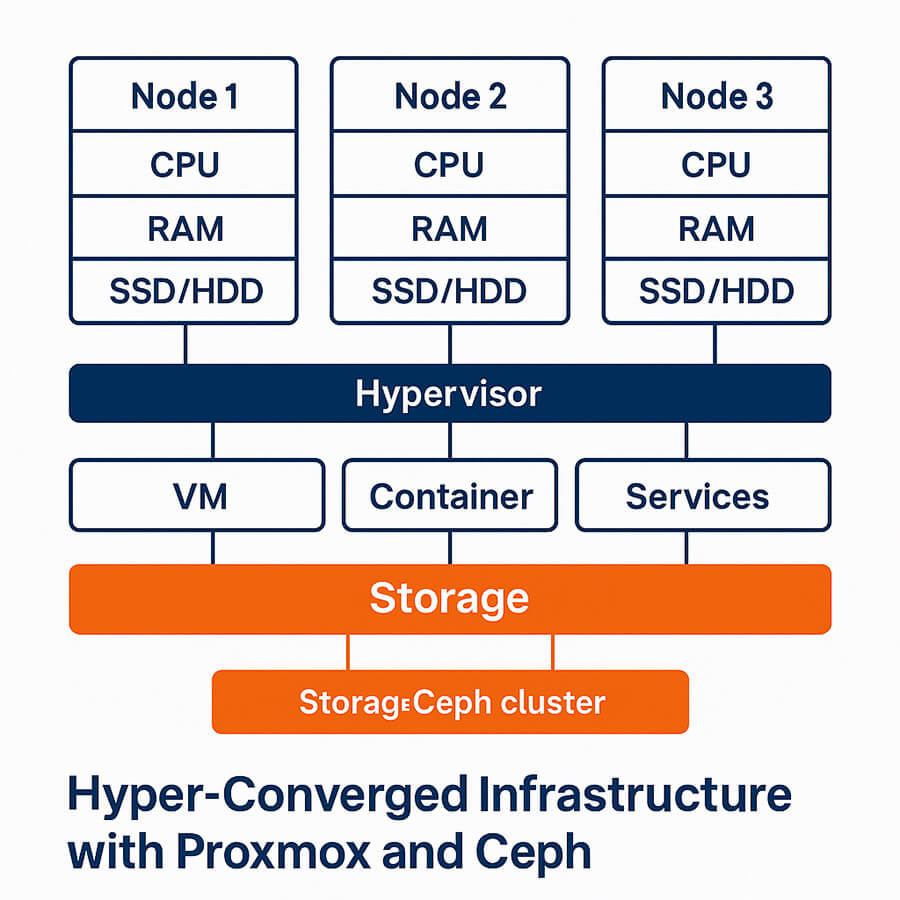
A typical hyperconverged system is based on:
- compute nodes: standard x86 servers with an integrated hypervisor, such as Proxmox VE
- distributed storage: software-defined solutions such as Ceph, which aggregate local disks into a single, redundant pool
- high-performance networking: 10/25/40 GbE switches or higher to ensure fast replication and communication between nodes
- orchestration platform: a graphical interface or API for managing the entire environment from a single point
How a hyperconverged system works
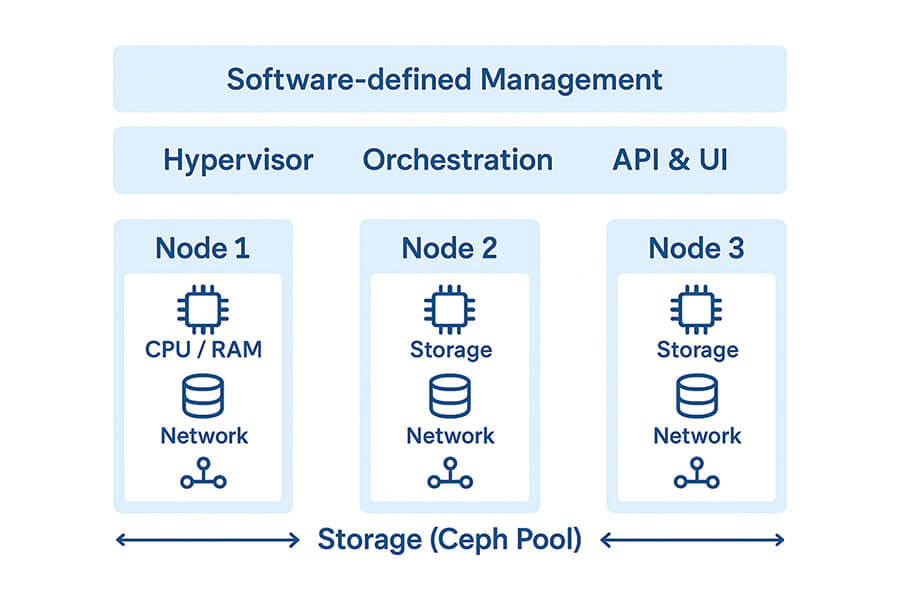
At the heart of a hyperconverged infrastructure (HCI) system is the cluster: a set of interconnected physical servers, or nodes, that operate as a single logical entity. Each node provides compute resources (CPU and RAM), local storage (SSD/NVMe and HDD drives), and network connectivity, which are abstracted and managed by a software layer. This system distributes and balances workloads, ensuring resource optimization and business continuity.
Operating principles
- Server virtualization: each workload runs on virtual machines (VMs) or containers, isolated yet scalable environments that can be easily migrated between cluster nodes.
- Unified distributed storage: with systems such as Ceph, the disks on each node are aggregated into a single storage pool, providing automatic replication, redundancy, and self-healing in the event of failures.
- High availability and fault tolerance: the cluster eliminates single points of failure, ensuring that services remain active and data remains accessible even if a node fails.
An HCI cluster can be viewed as a dynamic fabric, in which each node contributes to the whole and can be added or replaced without significant downtime, enabling much simpler horizontal scalability compared to traditional data centers.
The role of virtualization
Virtualization is the key technology that enables hyperconvergence. Using a hypervisor such as Proxmox VE, based on KVM and LXC, the system separates the physical layer from the operating environment, creating VMs and containers that efficiently share the underlying hardware resources.
Main functions of the hypervisor
- Isolation and security: each VM operates in a separate environment, reducing the risk of interference or compromise.
- Centralized management: modern hypervisors allow you to manage complex clusters from a single console, automating operations such as live migration, snapshots, and load balancing.
- Multi-tenant support: separate environments can be run for multiple departments or customers while maintaining high performance and security.
Benefits of a hyperconverged infrastructure
Adopting hyperconverged infrastructure (HCI) means embracing an architectural model designed to optimize resources, reduce complexity, and increase the operational resilience of the data center. Thanks to a software-defined approach and centralized management of compute, networking, and storage, the benefits are both economic and performance-related.
- Horizontal scalability: in an HCI environment, scaling simply means adding new nodes to the cluster (scale-out), which are automatically integrated by the orchestration system. This eliminates the need for disruptive reconfigurations or downtime. Each added node contributes new compute resources (CPU and RAM) and storage, making scalability linear and predictable, ideal for environments that are constantly growing or experiencing variable load spikes.
- Lower costs
– Elimination of dedicated SAN/NAS systems: storage is aggregated and managed in a distributed manner, reducing reliance on proprietary hardware.
– Optimized TCO: fewer devices, lower power consumption, and simplified management lead to lower operating costs.
– Subscriptions and maintenance: thanks to open-source solutions such as Proxmox and Ceph, subscription costs can be significantly lower than with many proprietary alternatives while still providing enterprise-grade functionality. - High Availability (HA): an HCI cluster distributes data and services across multiple nodes, ensuring native fault tolerance. In the event of a node failure:
– VMs are automatically restarted on available nodes
– replicated data remains accessible at all times, with no service interruptions. This architecture minimizes single points of failure, increasing the overall reliability of the system. - Simplified management: a unified console allows you to manage the entire infrastructure, including VM provisioning, network configurations, load balancing, snapshots, and backups. Day-to-day administration becomes faster, with fewer errors and reduced response times.
- Optimized performance: distributed storage with Ceph leverages replication, striping, and intelligent caching, using SSDs or NVMe as cache tiers, improving IOPS and latency. This enables support for mission-critical workloads such as transaction-intensive databases, VDI, or AI/ML applications that require high throughput and low latency.
Market Solutions: Proxmox and Ceph
When it comes to hyperconvergence, many vendors offer expensive and complex proprietary solutions. However, Proxmox VE has established itself as one of the most comprehensive and reliable open-source solutions for virtualization and HCI.
Why choose Proxmox VE?
- Built-in hypervisor: supports both virtual machines (KVM) and containers (LXC).
- Cluster management: allows you to create high-availability environments with just a few clicks.
- Intuitive web UI: simple, centralized management even for complex infrastructures.
Integration with Ceph
Ceph is a distributed storage technology that allows you to pool the disks of multiple nodes, creating a redundant, scalable, and high-performance storage system.
In a Proxmox cluster, Ceph ensures:
- resilience: data is automatically replicated across multiple nodes;
- scalability: simply add new disks or servers to increase capacity;
- flexibility: ideal for variable workloads and on-demand storage.
Who is it for?
- Medium-sized and large companies that want to reduce costs without compromising performance and reliability.
- Public-sector organizations and academic institutions that require secure, open-source, and scalable infrastructure.
Learn more about this topic with the comparison between the Proxmox hypervisor and VMware.
FAQ on Hyperconvergence
- What is hyperconvergence?
- Hyperconvergence is an IT model that integrates compute, networking, and storage into a single software-defined platform, simplifying management and reducing costs.
- What are the benefits of a hyperconverged system?
- Modular scalability, lower TCO, unified management, high availability, and high performance.
- What is a Proxmox hyperconverged system with Ceph, and how is it implemented?
- It is an open-source solution that combines the Proxmox VE hypervisor with Ceph distributed storage. The process starts with compatible servers: install Proxmox VE, configure Ceph for distributed storage, and then create a high-availability cluster through the management interface.
- What is the difference between a traditional server and a hyperconverged server?
- In a traditional model, servers, networking, and storage are separate, while in HCI they are unified and managed through software.